WonderArk
B2B · SMB operating platform · Live platform · modules rolling out
One login. Every part of your business. Zero duplicate data.
Five licensable modules on one shared data model — not five apps stitched together with exports. License what you need today; add a module later and it already knows your customers, items and team.
- Platform
- Web · responsive · mobile-friendly field work
- AI
- OpenAI, Anthropic, Google — BYOK or platform key
- Data
- Supabase PostgreSQL, schema-per-module, RLS tenant AND licensed
- Pricing
- Free · Pro (per module) · Max (bundle)
The problem
Growth turns into a pile of tools.
A business that starts on spreadsheets ends up with a CRM, an inventory app, a field-service tool, a chat inbox and a GST portal — five logins, five customer records, five inventory counts.
- 1
Duplicate everything
The same customer exists in the CRM, the invoicing tool and the WhatsApp inbox, with three different phone numbers.
- 2
Stock that disagrees
The count in the inventory app never matches the parts a field crew actually used on a job.
- 3
Compliance by re-entry
GST returns, e-invoices and e-way bills are re-keyed from sales data that already exists somewhere else.
- 4
Integration tax
Every 'integration' is an export, an import and a person who owns the spreadsheet in between.
The product
One portal. One account. Five modules. One truth.
A strictly bounded modular platform: a shared core schema owns every cross-module noun — parties, items, documents, payments, messages — and each module owns only what is genuinely its own.
01
Discovery
AI-generated ideal customer profiles, prospect discovery with fit and timing scores, why-them and why-now evidence, one-click hand-off to the pipeline. AI researches; humans approve every outreach.
02
Inventory & Service
Multi-warehouse stock, purchase and sales orders, returns; opportunity-to-job pipeline, crew dispatch calendar, mobile field work with time, notes and signatures, and job invoicing that consumes stock.
03
CRM
A unified inbox across WhatsApp, email and more, routing rules, lead lifecycle and a follow-up queue — tied to the same customer record every other module uses.
04
Finance & GST
GSTIN management, e-way bills, e-invoicing and GST returns computed from actual sales data rather than re-entered.
How it works
From signal to outcome.
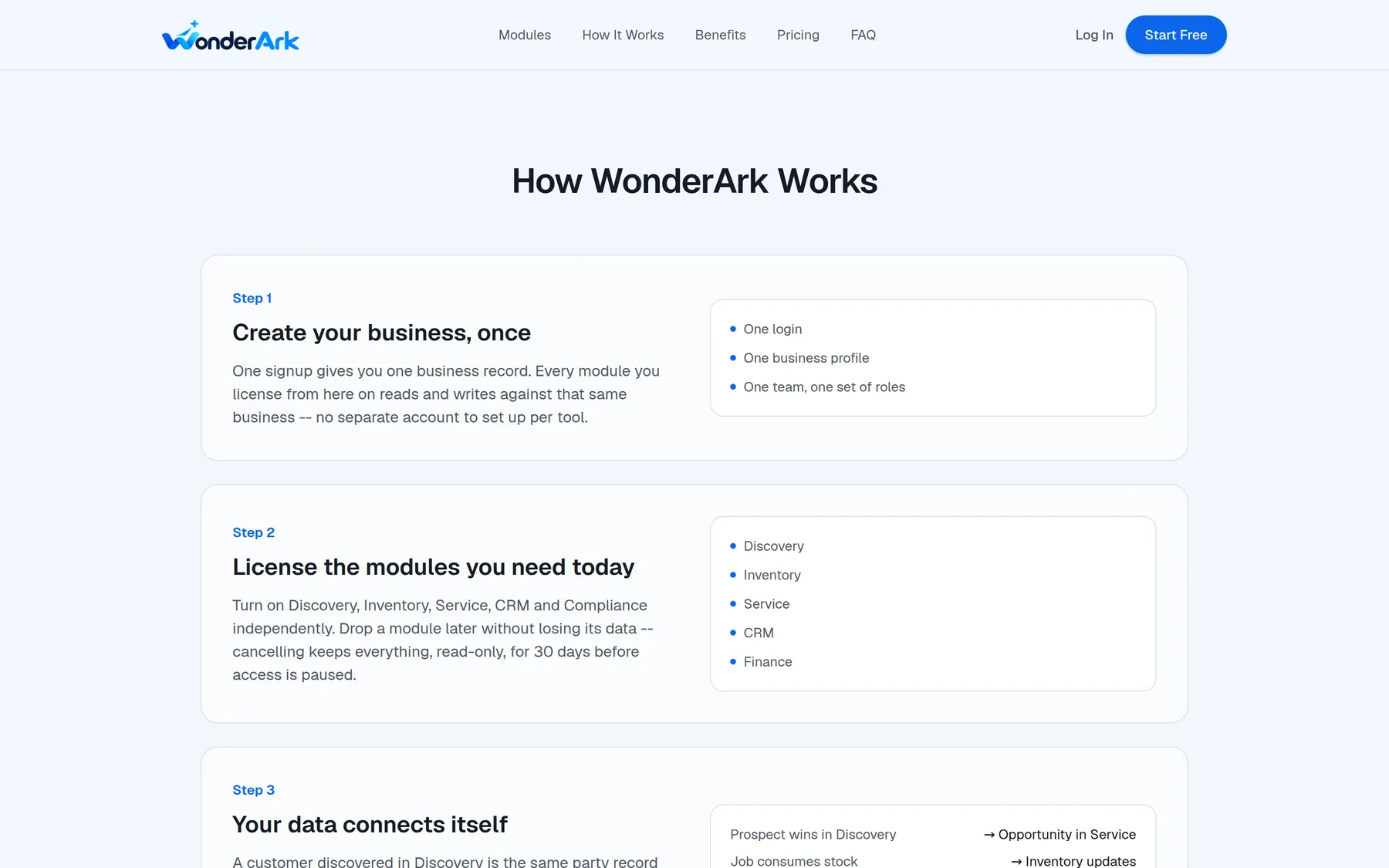
Step 1
Create the business once
One signup, one login, one business record — or several businesses under one account.
Step 2
License modules independently
Start with one. Add or drop later. Cancelling never deletes data: a 30-day read-only grace, then rows are retained for reactivation.
Step 3
Data connects automatically
A prospect won in Discovery is the customer in Service. Parts consumed on a job move stock in Inventory. The invoice feeds GST.
Step 4
Ask the platform
A built-in assistant answers from live data across every module you have licensed, grounded in real records.
Product tour
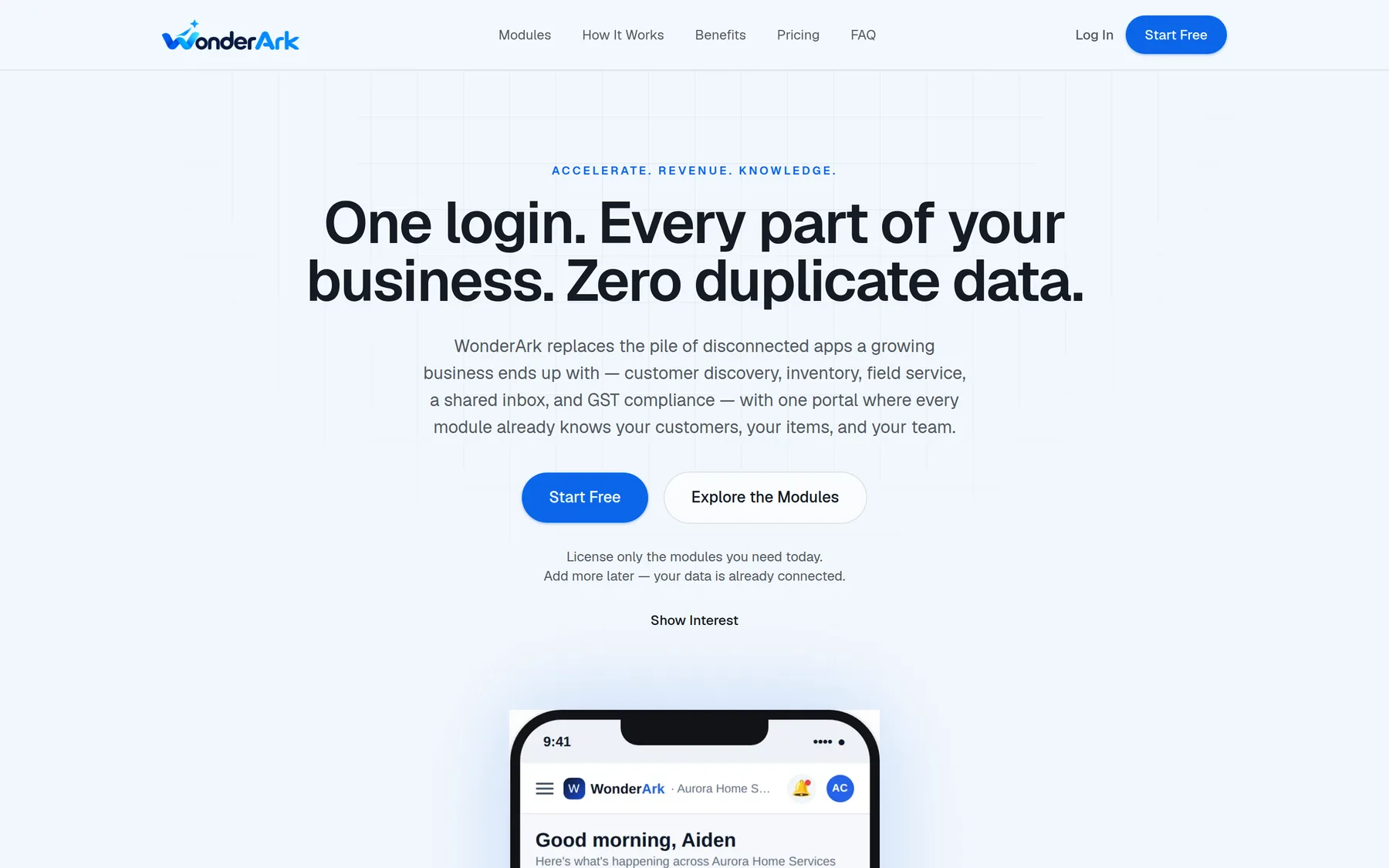
Desktop and mobile, one product.
Captured from the deployed product. Some views show demonstration data.
The five modules on one shared data model
Responsive across devices
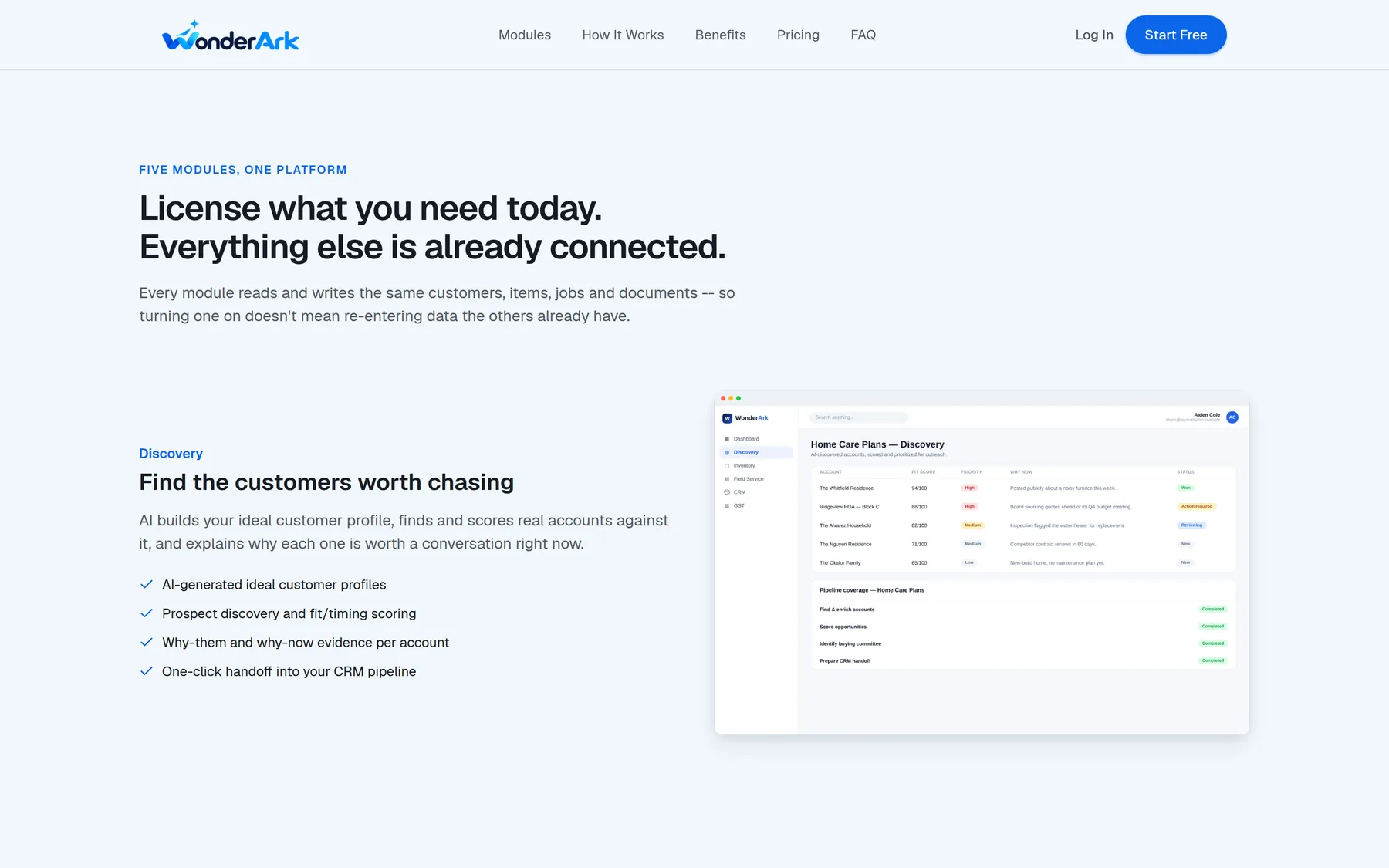
Module detail — independently licensable
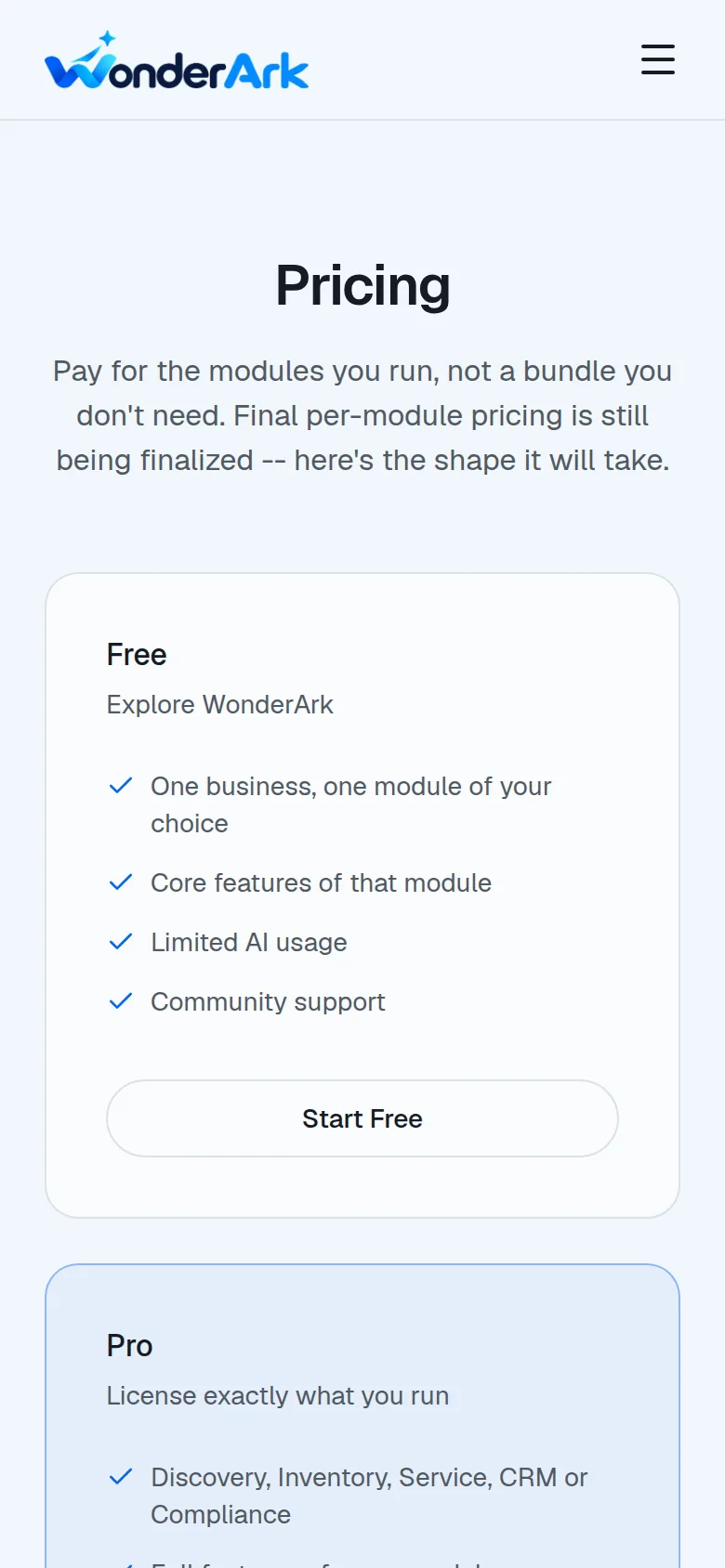
Free, Pro and Max
License what you need; add modules in place
Market & why now
The mid-market between spreadsheets and SAP.
Businesses with a warehouse, a field crew, a sales pipeline and a tax identity — trades, distributors, installers, service companies — are too complex for a single-purpose app and too small for an enterprise suite. India's GST regime makes structured, compliant data non-optional.
Who buys
- Field-service and installation businesses
- Distributors and traders managing multi-warehouse stock
- Founder-led B2B companies building their first pipeline
- Any GST-registered business filing from real sales data
Why now · 1
E-invoicing and e-way bill mandates keep widening the set of businesses that must operate from clean, connected data.
Why now · 2
AI makes prospect research and multi-module querying practical for a business with no analyst.
Why now · 3
Modular licensing lets a customer start small and expand in place — the land-and-expand motion vertical SaaS lacks.
Business model
License by module. Expand in place.
Per-module subscriptions with a bundle at the top. Enforcement is four layers deep — RLS, route guard, server action and UI — so an unlicensed module is genuinely off, not merely hidden. Final per-module pricing is being finalised.
Free
One business, one module
- Core features of the module you choose
- Limited AI usage
- Community support
Pro
Per-module licensing
- Full features of every module you license
- Automatic data sharing across licensed modules
- Cancel anytime; 30-day read-only grace
Max
All five modules
- Team roles and permissions across modules
- Priority support
- Advanced usage limits
Defensibility
What compounds.
The entity-ownership map
A prospect, a customer and a supplier are one party row with several roles. An estimate, an invoice and a purchase order are one documents table. This anti-duplication contract is the product.
Proven components, new chassis
Discovery is ported from a working GTM product; Inventory and the GST engine from a working operations product. Service is built fresh against a well-documented reference category.
Cancel-safe by design
Licensing never deletes data and reactivation replays parked events — the confidence a business needs to try a module.
Execution to date
Verifiable, not aspirational.
Pulled from the product's own public engineering trackers. Source code, trackers and live demos are available to serious parties on request.
Architecture decisions
13 ADRs
All signed off; enforced by CI import-boundary and migration lints
Modules
5 on one schema
Discovery, Inventory, Service, CRM, Finance — independently licensable
Enforcement
4 layers
RLS · route guard · server action · registry-driven UI
Region
ap-south-1 (Mumbai)
Tenant isolation at the database layer; full audit trail
Roadmap
What comes next.
Now
- Finance module and GST filing flows
- Platform admin portal
- UI design refresh across the shell
Next
- CRM channel connectors (WhatsApp, email)
- Team roles and permissions across modules
- Per-module pricing and billing
Later
- Public API and partner integrations
- Additional compliance regimes beyond GST
- Independent deployability per module as scale demands
The ask